Differential Pressure Transmitter (DPT) Level Measurement for Tanks
DP transmitter level measurement is one of the most reliable methods used in process industries for accurate tank level monitoring in open tanks and closed tanks. It helps prevent overflow, pump dry-run, and process shutdown by providing stable 4–20 mA output. Accurate tank level measurement is one of the most critical tasks in process industries such as chemical plants, oil & gas refineries, power plants, water treatment units, and food processing industries. A wrong level reading may look like a small error, but in reality it can cause tank overflow, pump dry runs, batch rejection, or even unsafe plant shutdowns.
That’s why engineers across industries rely on differential pressure transmitter (DPT) level measurement. It is simple, reliable, cost-effective, and works efficiently even in harsh industrial environments.
This guide explains DP transmitter level measurement step-by-step for open and closed tanks
How DP Transmitter Level Measurement Works
A differential pressure transmitter measures the difference between two pressures:
- HP (High Pressure) side = pressure due to liquid column
- LP (Low Pressure) side = pressure due to vapor space (in closed tanks) or atmospheric pressure (in open tanks)
This pressure difference is converted into a 4–20 mA output, which represents the tank level. This method is widely used because DPT level measurement is stable and suitable for most liquids.
Explore our full range of smart pressure transmitters and level transmitters for industrial automation applications.
A. Open Tank DP Transmitter Level Measurement
In an open tank, the top of the tank is exposed to the atmosphere. That means the LP side pressure is atmospheric and cancels out.
So, the DPT measures only the pressure created by the liquid height.
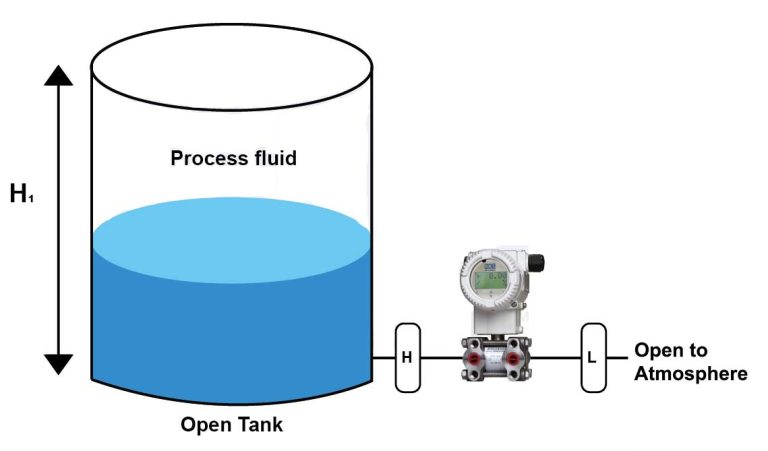
Formula for Open Tank DP Transmitter Level Measurement
P = H × SG
Where:
- P = Pressure (mmWC / mmH₂O)
- H = Height of liquid column (mm)
- SG = Specific Gravity of liquid
Example Calculation (Open Tank)
Suppose the tank height H₁ = 10 m.
At LRV (0% level):
Height = 0 mm → Pressure = 0 mmWC
At URV (100% level):
Height = 10,000 mm (10 m) with SG = 1 → Pressure = 10,000 mmWC
DPT Range: 0 to 10,000 mmWC
Open Tank Pressure Table
| Specific Gravity | Height | Pressure | Description |
|---|---|---|---|
| 1.0 | 10000 mm | 10000 mmWC | Water |
| 0.85 | 10000 mm | 8500 mmWC | Oil |
| 2.0 | 10000 mm | 20000 mmWC | Heavy Liquid |
This clearly shows that higher SG = higher pressure, even if tank height is the same.
B. Closed Tank DP Transmitter Level Measurement
Closed tanks are common in industries handling volatile liquids, pressurized chemicals, steam-based systems, and fuel storage.
In a closed tank, the top side contains vapor pressure, which affects level measurement. That is why DPT is the best instrument here.
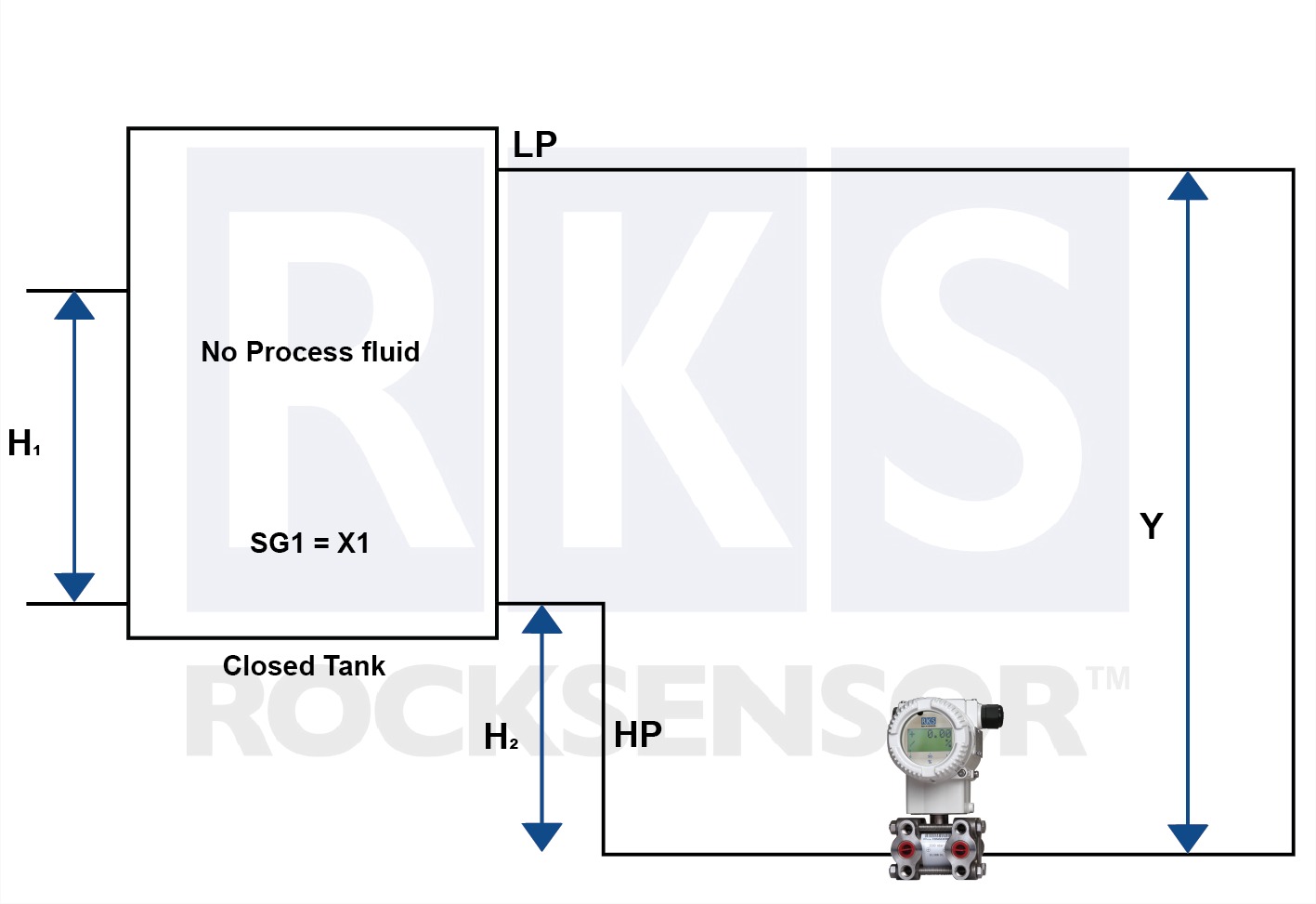
Closed Tank Formula
DP = A – B
Where:
- DP = Differential Pressure
- A = Pressure at HP port (liquid column pressure)
- B = Pressure at LP port (vapor space pressure)
In most cases, vapor pressure is present equally at both sides, so it cancels out.
LRV Calculation in Closed Tank DP Transmitter Level Measurement
Suppose
- H1 = 10 m (measuring span)
- H2 = 1 m (transmitter below tank bottom)
- SG = 1
Pressure at HP side:
HP pressure = H₂ × SG = 1000 × 1 = 1000 mmWC
LP pressure:
LP side senses vapor pressure only (same as tank top pressure)
DP at LRV: 1000 mmWC
URV Calculation in Closed Tank DP Transmitter Level Measurement
At 100% level, total liquid head becomes
H = H1 + H2 = 10 m + 1 m = 11 m = 11000 mm
HP pressure:
HP pressure = 11000 × 1 = 11000 mmWC
LP pressure:
LP pressure = vapor pressure (same and cancels)
DP at URV: 11000 mmWC
Closed Tank DP Table (Correct Range)
| H1 (m) | H2 (m) | SG | LRV (mmWC) | URV (mmWC) |
|---|---|---|---|---|
| 10 | 1 | 0.85 | 850 | 9350 |
| 10 | 1 | 1.0 | 1000 | 11000 |
| 10 | 1 | 2.0 | 2000 | 22000 |
This is the standard DPT calculation for a closed tank with dry leg.
Why Specific Gravity Matters in DPT Level Measurement
Many engineers assume tank level depends only on height, but DPT works based on hydrostatic pressure.
That’s why a DPT calibrated for water will give wrong readings if used for oil or heavy liquids without recalibration.
To ensure accuracy:
- Always confirm SG
- Set correct LRV and URV
- Apply temperature correction if needed
Installation Tips for DP Transmitter Level Measurement
A DPT can give extremely stable results if installed correctly.
Best Practices
- Use proper impulse line routing to avoid bends and long piping errors
- Use drain valves to remove trapped air or sludge
- Use condensate pot (for steam services) to maintain stable wet leg pressure
- Use isolation valves for safe maintenance
These small installation steps improve measurement stability in real plant conditions.
Conclusion: DP Transmitter Level Measurement for Tanks
DPT level measurement is one of the most reliable and widely used techniques in process industries. For open tank level measurement, the formula is simple: P = H × SG. For closed tank level measurement, DPT works efficiently by canceling vapor pressure effects and providing accurate output.
By selecting the right transmitter range, setting proper LRV/URV, and considering specific gravity, engineers can ensure long-term stable level measurement.
Contact us today for a free consultation!
Email: info@rocksensor.in | www.rocksensor.in
FAQs – DPT Level Measurement
1. What is the working principle of a DPT in level measurement?
A differential pressure transmitter measures the pressure difference between HP and LP ports. This pressure difference is proportional to the liquid level inside the tank.
2. Why is DPT used for closed tank level measurement?
Because in closed tanks, vapor pressure changes frequently. A DPT cancels vapor pressure effects and measures only liquid head pressure.
3. How do you calculate DPT range for an open tank?
Use the formula: P = H × SG. LRV is at zero height, and URV is at maximum height.
4. How does specific gravity affect DPT level measurement?
Higher specific gravity produces higher pressure for the same level. If SG changes, the transmitter output will shift unless recalibrated.
5. Which industries commonly use DPT for tank level measurement?
DPT level measurement is widely used in chemical plants, oil & gas, power plants, water treatment, pharma, food processing, and refineries.