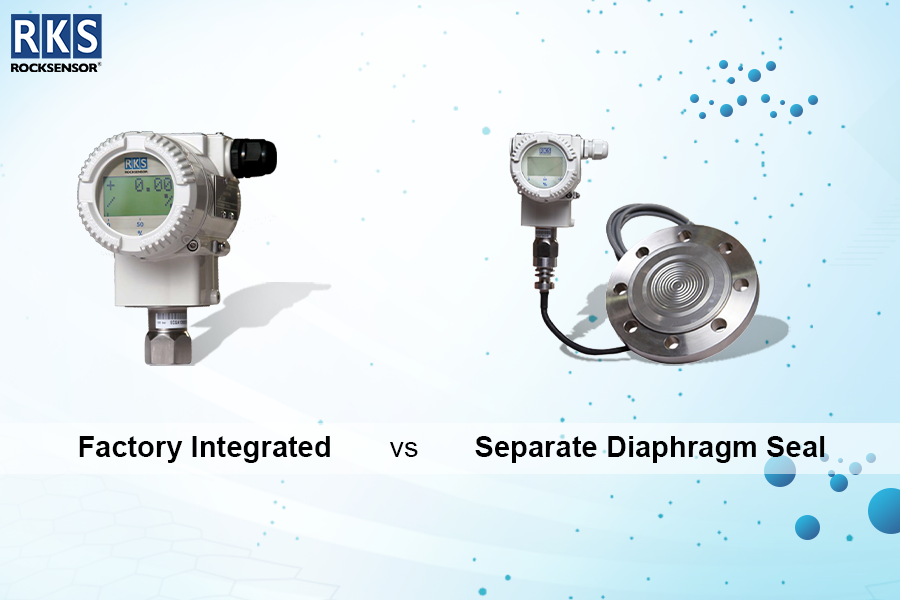
In the pressure transmitter industry, there is a distinct technical difference between integrated (factory-welded) assembly and modular (post-manufacture) addition of a diaphragm seal.
While modular seals offer field flexibility, manufacturing the seal as an integrated part of the sensor assembly provides superior performance in precision-critical applications.
1. Vacuum Integrity & Air Entrainment
The most critical benefit of manufacturing the seal during sensor assembly is the vacuum-fill process.
- Integrated Assembly: The sensor and seal are evacuated of air simultaneously in a high-vacuum chamber before being filled with de-gassed oil. This ensures zero micro-bubbles in the system.
- Separate Addition: When a seal is added to a pre-manufactured transmitter, the “dead volume” in the transmitter’s neck must be filled. It is much harder to eliminate all the air at the connection point. Air is compressible; even a tiny bubble will cause a “spongy” response and significant measurement errors as it expands/contracts with temperature.
2. Thermal Stability & Temperature Drift
The fill fluid (silicone oil, Halocarbon, etc.) expands as temperature rises.
- Integrated: Manufacturers can minimise the total fill volume by optimising the internal cavities during assembly. Less oil means less thermal expansion, resulting in lower “Temperature Effect” errors.
- Separate: Adding a seal later usually involves adaptors or longer “necks,” which increases the volume of oil. This makes the sensor more prone to zero drift when the ambient or process temperature changes.
3. Response Time
Pressure is transmitted from the seal to the sensor through the fill fluid as a hydraulic signal.
- Integrated: Direct welding and optimised internal pathways reduce the distance the pressure wave must travel. This leads to a faster response time (often <100ms).
- Separate: The use of threaded joints or additional gaskets in a post-manufactured setup can create “flow restrictions” or damping, slowing down the transmitter’s ability to react to rapid process changes.
Comparison Summary
| Feature | Integrated Assembly (OEM) | Separate Addition (Modular) |
| Leak Paths | Minimal: All-welded construction eliminates threaded joints. | Higher: Multiple-threaded or gasketed joints. |
| Accuracy | High: Factory calibrated as a single unit. | Lower: Requires field recalibration/offsetting. |
| Durability | High: Resistant to high vibration and spikes. | Moderate: Joints can loosen over time. |
| Cost | Higher initial cost; lower maintenance. | Lower initial cost; higher leak risk. |
| Application | Best for Vacuum, High-Temp, Purity. | Best for Standard Water/Gas or retrofits. |
Which should you choose?
- Choose Integrated Manufacturing if you are working with vacuum applications, high-temperature steam (>150 deg C), or high-accuracy process control where a 0.1% error is critical.
- Choose Separate Addition only if you need a quick field replacement for a failed seal or if the process media is non-critical (e.g., simple wastewater) and the budget is the primary driver.
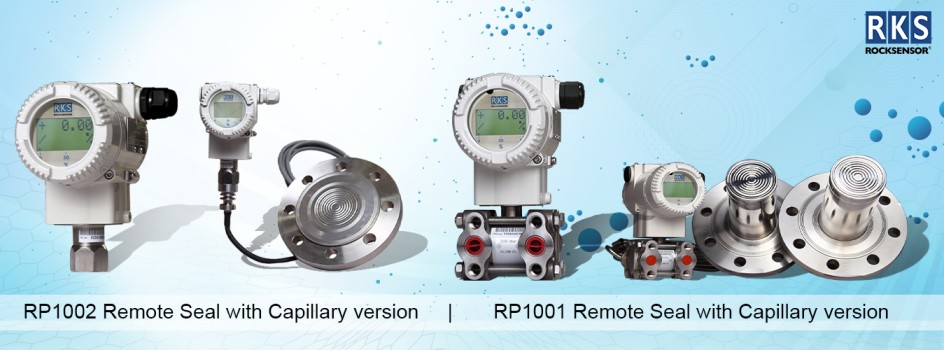

Looking for accurate and reliable process measurement instruments?
Explore Rocksensor’s complete range of Pressure, Flow, Level & Temperature transmitters.
Download datasheets | Get a quote | Enquire today