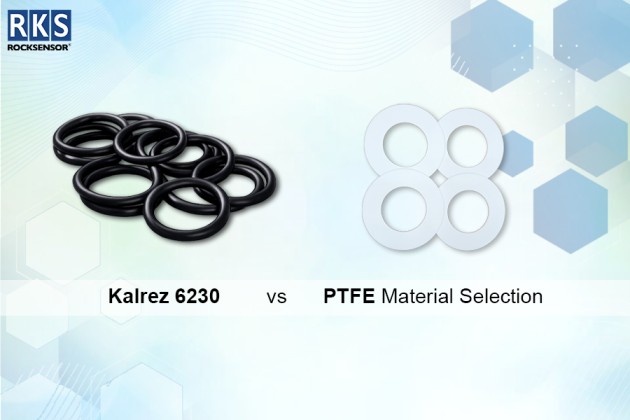
When comparing Kalrez® 6230 and PTFE, you are essentially looking at the two highest tiers of sealing materials. Both offer “universal” chemical resistance, but they function fundamentally differently in a mechanical system.
While PTFE is a rigid plastic, Kalrez® 6230 is an FFKM (perfluoroelastomer)—a material that combines the chemical inertness of PTFE with the elastic “spring-back” of rubber.
Critical Comparison Table
| Feature | Kalrez® 6230 (FFKM) | PTFE (Teflon™) |
| Material Class | Perfluoroelastomer (Rubber) | Fluoropolymer (Plastic) |
| Physical State | Flexible / Elastic | Rigid / Hard |
| Max Temp | 260 deg C/ 500 deg F | 260 deg C/ 500 deg F |
| Sealing Type | Active: Compresses and rebounds | Passive: Must be crushed to seal |
| Compression Set | Excellent (maintains seal force) | Poor (subject to “Cold Flow”) |
| Chemical Resistance | Near Universal (Steam, Acids, Bases) | Near Universal |
| Purity | High (FDA, USP Class VI compliant) | High (FDA compliant) |
| Typical Form | O-rings, Custom molded gaskets | Sheets, Gaskets, Valve seats |
1. Mechanical Behavior (The “Spring” Factor)
The biggest difference is memory.
- Kalrez® 6230: If you squeeze an O-ring made of Kalrez, it wants to push back against the sealing surface. This “seal force” is what prevents leaks during thermal cycling (when parts expand and contract).
- PTFE: PTFE has no memory. If you compress it, it stays deformed (this is called “Cold Flow” or “Creep”). In systems with temperature swings, PTFE seals often develop leaks because they cannot expand back to fill the gap as the metal hardware moves.
2. Steam & SIP Resistance
Kalrez® 6230 was specifically engineered for the Pharmaceutical and Food industries.
- It excels in Steam-in-Place (SIP) and Water for Injection (WFI) systems.
- While PTFE is also steam-resistant, the elastomeric nature of Kalrez® 6230 allows it to handle the repeated mechanical stress of steam cycling much better than a rigid PTFE gasket, which may require frequent re-torquing.
3. Installation & Hardware
- PTFE requires high bolt torque and very flat, smooth flange surfaces to create a seal because the material is so hard.
- Kalrez® 6230 is a 75 Shore A hardness elastomer. It can seal on slightly imperfect surfaces and requires much less force to “energise” the seal, making it ideal for delicate glass-lined or plastic equipment where high torque would damage the hardware.
When to use Kalrez® 6230 instead of PTFE?
- Dynamic Applications: Use Kalrez for any moving part (pumps, valves, agitators). PTFE is too abrasive and rigid for most dynamic O-ring grooves.
- Thermal Cycling: If your process goes from ambient to 200 deg C repeatedly, Kalrez will maintain the seal; PTFE will likely “creep” and leak.
- Low Contamination: Kalrez® 6230 is designed for ultra-low extractables, making it the gold standard for high-purity pharmaceutical manufacturing.
Looking for accurate and reliable process measurement instruments?
Explore Rocksensor’s complete range of Pressure, Flow, Level & Temperature transmitters.
Download datasheets | Get a quote | Enquire today